Tuesday, August 11, 2026
Chapter 4: Small Things That Don't Fit
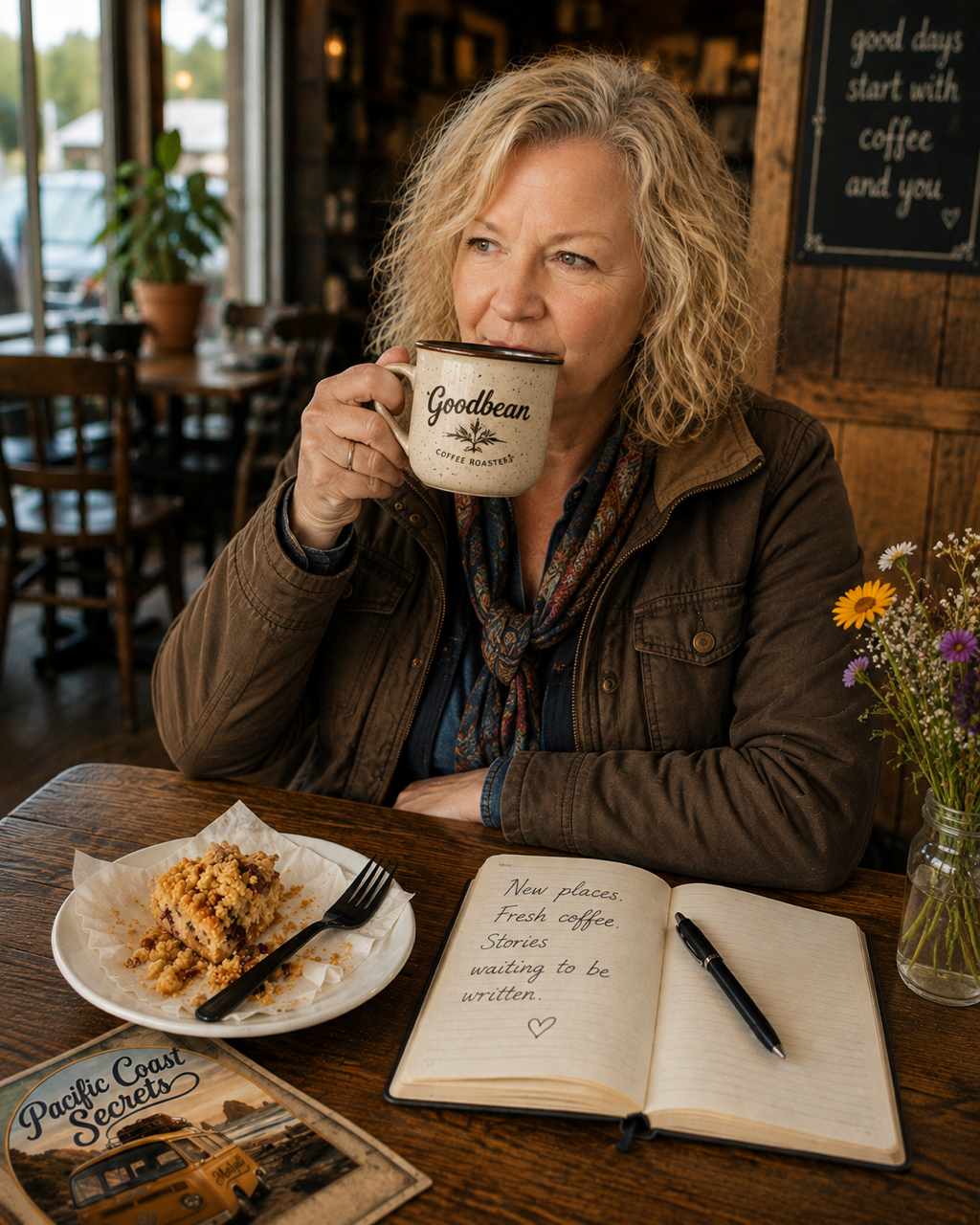
Chapter 4: Small Things That Don't Fit She gave herself one day. That was the bargain she struck in the bus on the hill. One day to satisfy the machinery, and then she would go south and let Astoria bury its own. She spent it the way she had spent a thousand working mornings, by walking a dead man's last hours backward. It was not hard. In a town this size a regular leaves a track, and Walt Geddes had been a regular everywhere. The woman at the inn knew him. The man sell-ing papers knew him. By mid-morning Nora had followed the track to a narrow café two streets up from the water, where a young barista with a nose ring went still when Nora said the name, and then said, quietly, that Walt had been in yesterday like always, before he went up the hill. "He had his usual," the girl said, wiping the same clean spot on the counter. "I made it myself." "What was the usual?" "Cardamom latte. Whole milk, two shots, a spoon of cardamom on top, not in it, on top." She almost smiled. "Fussy about it. Sweet, though. He always said please." Nora wrote it down, cardamom, on top not in, in the small even hand she had used on case notes for forty years, and as she wrote it she caught herself doing the thing she always did and had never once been paid to examine, which was the care. There was no client. That was the strange clean fact of it, standing at the counter with her pen. No one had hired her. No one would ever read this page. No one would ever know whether she got the coffee order exactly right or approximately right or wrong, and there was not a soul on this coast who would think one inch less of her if she simply drank her tea and drove south and let the county call it a fall. And she was writing on top not in anyway, because the order was on top and not in, because that was what had happened and she was constitutionally unable to set down a thing that had happened as anything other than exactly what it was. She had spent her whole life doing the work to a standard no one had asked for and no one had rewarded. She saw that plainly now, in the way you see the shape of your own life only once it has mostly gone by. For forty years the meticulousness had been poured out into other people's cases and other people's credit, the extra hour no one billed for, the detail no one noticed was the detail that cracked it. She had told herself the standard was for them, for the client, for the truth of the thing. But the clients were gone now, and the marriage was gone, and the credit had always gone to someone else, and here she still was, at a café counter with no case and no name on any door, getting a dead stranger's coffee order right to the letter because the standard had never been for them at all. It had been hers. It was the one thing that had always been hers. If I am going to do a thing, she thought, pressing the last word into the page, I am going to do it as well as it can be done, and I am going to do it whether or not there is a single person left in the world to see that I did. That, she supposed, was what she had always meant by keeping sharp, though she had never let herself hear the whole of what the phrase carried. Not staying useful. Not staying employable. Just the plain refusal to become a person who did things halfway now that no one was checking. Best work for myself, she thought, and almost smiled at the counter, because it had taken her sixty-three years and an empty passenger seat to arrive at a creed that a happier person might have started with. The girl said Walt had taken his coffee to a table by the window and sat a while with a paperback, the way he did, and then walked up toward the Column the way he did, and that was the last of him. "The book," Nora said. "Do you remember the book?" The girl shook her head. But she remembered the bookmark, be-cause Walt had left it on the table, fallen out when he gathered his things, and she had meant to keep it for him and now there was no him to keep it for. She fished it out of the tip jar where she had tucked it. It was a slip of stiff cream card, a little foxed at the edges, and printed on it in a plain old-fashioned face was a line of words and nothing else, no shop name, no town. Found things, fairly priced. The stall travels. Nora turned it over. The back was blank. "A traveling stall," she said. "Antiques and old books. Comes through for the fairs." The girl gave a small helpless shrug. "It's around. You see it." Nora put the bookmark in her notebook between the pages, flat, the way you press a flower, and bought a coffee she did not want so the girl would have made a sale on a bad morning, and went out into the bright cold street with two more small wrong things added to the first. He was leaning against a lamppost across the way as though he had grown there. "You're still here," Elliot said, pleased, pushing off the post. "I had you halfway to Tillamook by now." "Change of plans." Nora kept walking and he fell in beside her, easy, matched to her pace before she had set it. "You get around for a man writing about a place he's only just arrived in." "That's the job. Wander, notice, write it down." He smiled side-ways at her. "You'd be good at it. You've got the noticing." He said it lightly and it landed heavy, and she let a few steps go by before she answered. "Did you know him? The man who died up at the Column." The smile did not move but something behind it did, a small re-calculation, there and gone. "I heard about it at the inn," he said. "Awful. Lovely town, terrible luck." Which was not an answer, and they both knew it was not an answer, and he changed the subject so smoothly that a person who had not spent forty years listening for exactly that move would never have felt the floor tilt. He asked where she was staying. He asked, again, lightly, where she was head-ed. And when she gave him nothing, he laughed and said he hoped their roads would cross, and peeled off down a side street with a wave, and was gone before she could decide whether to be charmed or alarmed, which was, she suspected, precisely the effect he was af-ter. She was still frowning after him when the woman with the cam-era spoke. "He's been everywhere I've been for three days." The woman was younger, thirties, with a serious face and a serious camera, the long lens of someone who took pictures for reasons rather than for fun. She was looking down the street where Elliot had gone. "I'm Priya. I'm documenting the coast. The real coast, the working parts, not the postcards." She turned the serious face on Nora. "You were up at the Column this morning. After they found Walt Geddes." Nora went carefully still. "I didn't catch your name in the paper." "I'm not in the paper. I just listen." Priya let the camera hang. "Walt Geddes. Sad. He kept to himself, mostly." She said the name the way you say a name you have written down before, with the small flat familiarity of a fact already filed, and Nora caught it, the way she caught everything, that this stranger documenting the work-ing coast already knew a dead man's full name, already knew where he kept to himself, and had not had to ask anyone a single thing. "Did you know him?" Nora said, for the second time in ten minutes. "No," Priya said, and lifted the camera again, and that was the end of it, and she drifted off up the street taking pictures of nothing in particular, which a person does when she does not want to be asked anything else. Nora stood alone on the bright sidewalk with her notebook full of small wrong things, the angle and the coffee and the bookmark and the two strangers who both knew more than they would say, and underneath all of it the other thing, the thing she had carried down off the hill and could not set down. Walt's face. The trusting bones of it, looking up at the sky. I knew that man, she thought, with no evidence and total certain-ty. Not from a corridor in Tacoma. From somewhere else. From a long, long time ago. She just could not yet think where.